
Soft-Tec® leaves calcium and magnesium in the water and stops them bonding. A salt softener takes them out of the water entirely. If the goal is genuinely soft water rather than scale control, this is the one that does it.
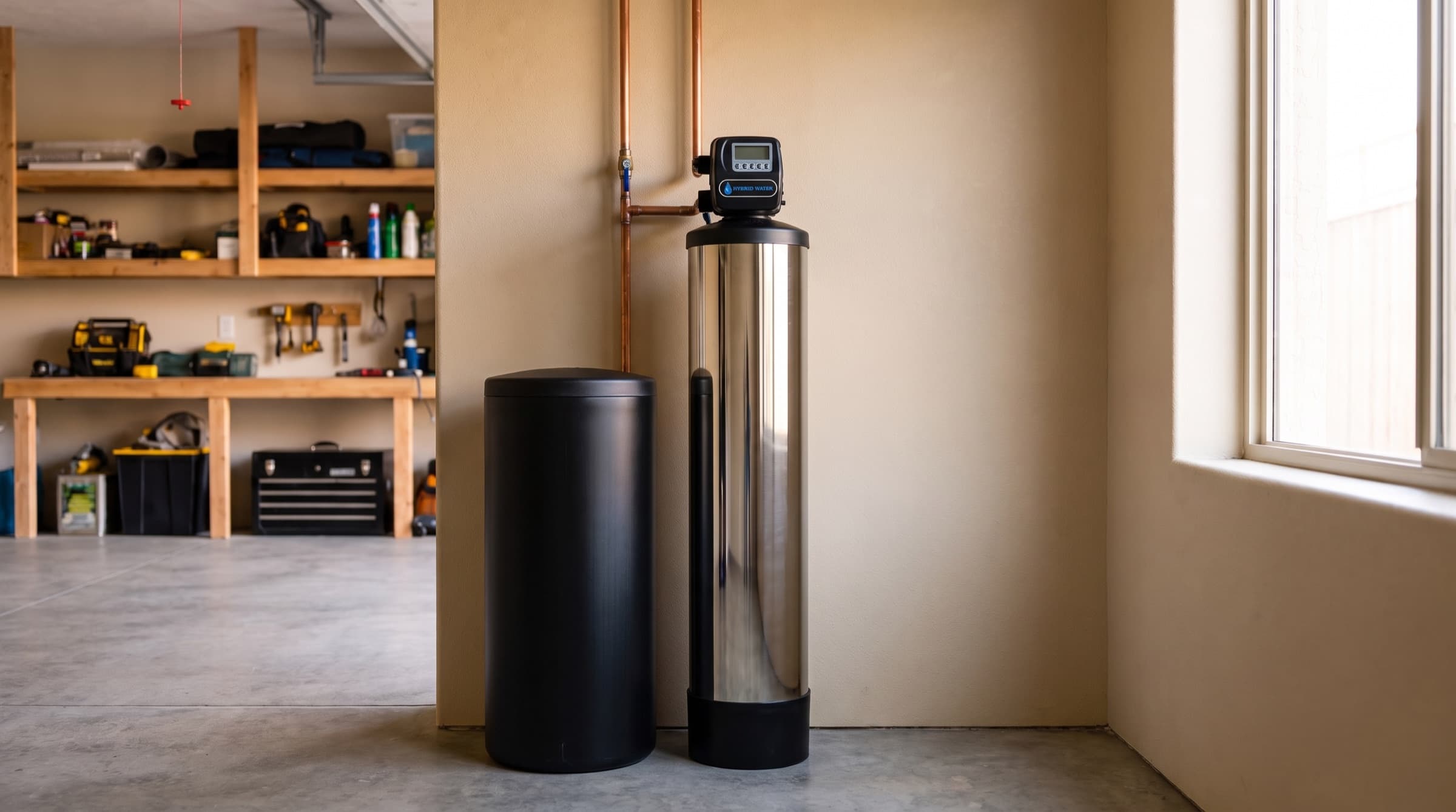
The Hybrid Water Softener
Salt, when salt is the answer.
A traditional ion-exchange softener that pulls the hardness out of your water instead of restructuring it. Same install team, different tool for a different problem.
Which one you want
Salt is not the old way. It is the other way.
We sell both, so we have no reason to talk you into the wrong one. Three cases where a softener beats salt-free outright.
That distinctive feel in the shower comes from removing hardness minerals. Salt-free will not produce it, and we would rather tell you that now than after the install.
Well water often carries iron, manganese, and sulfur, and Soft-Tec® needs those at essentially zero. A softener, sometimes with pretreatment ahead of it, is usually the workable path.
What is inside
Multi-Stage Filtration
Coconut Shell Carbon
Reduces chlorine and chloramine taste and odor
Made from coconut shell, a renewable material
Built for maximum capacity and extended performance
High-Capacity Softening Resin
10% crosslinked resin removes hardness and lasts longer
Resists chlorine and oxidation for a longer lifespan
Sized for whole-home flow rates
Polishing Gravel
Supports the resin bed for optimal flow and efficiency
Prevents channeling for even water distribution
City water versus well water.
City Water
Treated, but not clean
Municipal water is treated to meet safety standards, but treated isn't the same as clean. What comes out of the tap still carries chlorine and chloramines, fluoride, volatile organic compounds, and the hard minerals that wreck your fixtures.
What may be in it
- Chlorine & chloramines
- Fluoride
- VOCs
- Hard minerals
Well Water
Natural, but unregulated
Well water never passes through a municipal plant, so nobody is checking it but you. Depending on your aquifer it can carry bacteria and viruses, iron, manganese, sulfur, sediment, and nitrates.
What may be in it
- Bacteria & viruses
- Iron & manganese
- Sulfur
- Nitrates & sediment
A water test tells us which of these are actually in your water. A softener removes hardness. It does not treat bacteria, viruses or nitrates, and we will tell you if your water needs something else first.
Sizing a softener for Arizona water.
A softener is sized in grains: how much hardness it has to pull out of your water between regenerations. That depends on two numbers, how hard your water is and how much of it your household uses. Get either one wrong and the system regenerates too often, using more salt and water than it needs, or runs out and lets hard water through.
Here is what the utilities themselves publish for the cities we serve most:
| City | Published hardness | Source |
|---|---|---|
| Phoenix | 10 to 17.6 gpg | City of Phoenix 2025 Water Quality Report, page 4 |
| Scottsdale | 13 to 17 gpg | Scottsdale Water 2025 Water Quality Report, page 4 |
| Mesa | 0.4 to 25 gpg | City of Mesa 2025 Water Quality Report, pages 1 and 11 |
| Chandler | 10.1 to 16.8 gpg | City of Chandler 2025 Drinking Water Quality Report, page 3 |
| Gilbert | 6.6 to 17.5 gpg | Town of Gilbert 2025 Water Quality Report, pages 2, 7 and 8 |
| Marana | 8 to 18 gpg | Marana Water hardness table, October 2024 |
| Oro Valley | 2.1 to 15.8 gpg | Oro Valley Water Utility, Water Quality page |
As an example, a household using 300 gallons a day on water at 17.6 gpg, the top of Phoenix's published range, asks its softener to remove about 5,280 grains every day. That is why we test your water and ask how many people live in the house before we quote a size. Tucson Water publishes hardness by address rather than as one range, so in the Tucson area the test matters even more. Hardness city by city.
Start with a free quote.
A tech tests your tap, tells you whether salt or salt-free suits your chemistry, and puts one number in writing before anything is installed.
